


24
Train Safety
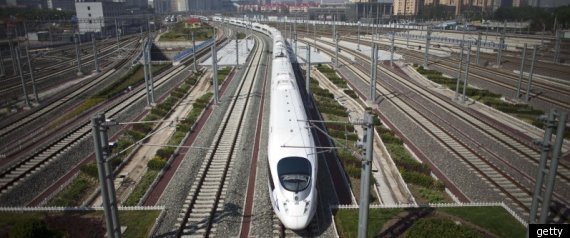
The recent accident in Wenzhou has highlighted some of the issues that are present in train systems today.
The facts –
One high-speed rail train D301 from Beijing was headed for Fuzhou, this train was followed by train D3115 from Hangzhou to Fuzhou. At 20:34 or so, the train D3115 was hit by thunder, subsequently lost power and stopped.
Train D301 did not, and crashed into train D3115.
Two cars from train D3115 as well as four cars from D301 derailed, some falling off of a bridge.The trains are from different manufacturers –
D301 – CRH1 (Bombardier Regina, Swedish)
D3115 – CRH2 (Shinkansen E2, Japanese)
First – a quick overview of technology.
The 2 trains used come from different design ethos –
The Japanese design trains to travel fast, and light. The trains are fuel efficient.
They don’t design for crash safety, as the Japanese train system is designed explicitly with the idea that no train can crash into another; signalling and train positioning systems are used to ensure this.
This has been quite successful in Japan, and other countries where Japans system can be implemented.
This does mean that in the event of a collision, Japanese trains are more prone to derailment, as can be seen in this instance.
The Europeans design trains based on the idea that crashes or derailments happen.
This is mainly historical due to the mixture of systems in place throughout the European network, and track size, grade plus other issues not present in other rail systems.
This means european trains are heavier, require more power/fuel to run, but that derailment occurs less. European ‘safety’ standards (more on this later) ensure that European trains can withstand much higher impacts
than a Japanese train can.
In this case, the heavier European train crashed into the lighter Japanese train, and caused a derailment, with cars falling off the viaduct.
As far as I can tell, the news reports state that the driver of the D301 train manually activated braking, but it was too late to prevent the accident.
What could have been done to prevent this tragedy?
Lets take another look at the Japanese ethos – don’t crash.
The Japanese have an enviable safety record for their train systems, and for good reason, they track their trains carefully. Tracking doesn’t save lives though, stopping does. In most systems signals tell drivers to stop in case of emergency, but humans are fallable, and after some bad accidents due to human error in the 60’s, they took the human out of equation, and introduced automated stopping systems to avoid issues due to human error (ATS)
In the train industry there are two main implementations for arranging train movement – Moving Block, and Fixed block.
These both use similar idea’s – that two trains cannot occupy the same track at a given time.
To do this, they use signal systems on track to tell the driver to slow down or stop as appropriate.
This method of visual signaling has been around since the beginning of trains, and automated systems date back to the 1800’s.
Fixed block signaling works by breaking track into segments. If a train is on segment B, then a train in segment A cannot proceed until the other train has moved onto segment C.
Moving block signaling works by adding a virtual buffer zone around a train of a few hundred meters. If a train is on Segment B, then another train can proceed from A to B as long as the two trains are separated by the safe buffer zone difference.
Moving block signaling allows train companies to run trains closer together, but increases the danger risk.
With the invention of GPS, there is a another safety system coming into place called PTC (Positional Tracking Control)
With positional tracking control, each train gets fitted with a GPS device that tells relevant parties where the train is.
Those familiar with Onstar or other vehicle tracking systems will recognize the concept.
Essentially each train reports back its location to a central location, and this gets updated in some kind of tracking control system.
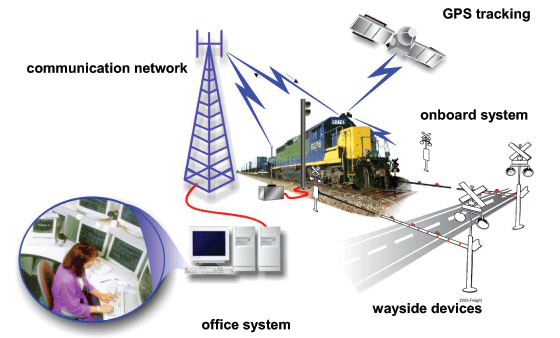
This can be added to existing systems to warn about crash collisions. Positional tracking control is known as Positive Track Control in the train world (PTC).
Given that there are a number of safety systems in place, and some countries have been using them successfully for many years, what is in use in China?
China unsurprisingly, does have safety systems in place, as one would expect given the major train network here, and the amount of train traffic on those networks. Anyone who has noted the immense amount of train travel during Chinese New Year will know this.
China has a reasonably good train safety record despite its traffic volume, so what happened here?
According to early reports the PTC system failed in this instance. China uses the European PTC system, known as ERTMS. While its too early to know what exactly happened, this isn’t looking very good for the Europeans, as their system failed, and failed badly.
References:
http://www.jrtr.net/jrtr21/F44_Technology.html
http://www.railjournal.com/this-month/yet-more-ertms-challenges-ahead.html
http://www.accessscience.com/content/Positive%20train%20control/YB110191
Do you like this article? Share It!


Archives
- November 2024
- November 2019
- October 2019
- August 2019
- April 2019
- February 2017
- September 2016
- June 2016
- May 2016
- September 2015
- August 2015
- June 2015
- April 2015
- December 2014
- October 2014
- September 2014
- July 2014
- June 2014
- April 2014
- October 2013
- July 2013
- May 2013
- April 2013
- March 2013
- January 2013
- December 2012
- October 2012
- August 2012
- July 2012
- June 2012
- May 2012
- April 2012
- March 2012
- December 2011
- November 2011
- October 2011
- September 2011
- July 2011
- May 2011
- April 2011
- March 2011
- February 2011
- January 2011
- December 2010
- November 2010
- October 2010
- September 2010
- August 2010
- July 2010
- June 2010
- May 2010
- April 2010
- March 2010
- February 2010
- January 2010
- December 2009
- November 2009
- October 2009
- May 2009
- April 2009
- March 2009
- February 2009
- January 2009
- December 2008
- November 2008
- October 2008
- September 2008
Categories
- Apple
- Arcade Machines
- Badges
- BMW
- China Related
- Cool Hunting
- Exploits
- Firmware
- Food
- General Talk
- government
- IP Cam
- iPhone
- Lasers
- legislation
- MODx
- MySQL
- notice
- qmail
- requirements
- Reviews
- Service Issues
- Tao Bao
- Technical Mumbo Jumbo
- Things that will get me censored
- Travel
- Uncategorized
- Useful Info


